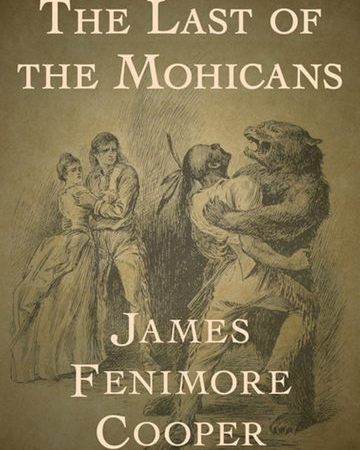
This classic work first appeared in 1826 and in the 20th century was rendered in film nearly a dozen times. This is the second of five books in Cooper’s Leather Stocking series (leather stockings being boots), featuring the frontiersman known as Hawkeye. (The character once refers to himself as “Nathaniel,” but nowhere in the book does the name “Natty Bumppo” appear.)
From a modern perspective, the book drags itself through events, but the action scenes were probably rather daring by early 19th-century standards. Frankly, it took me months to get through the nearly 500-page tome.

The story is set during the French and Indian War in 1757, a period predating Cooper’s life by several decades, but well within memory of his grandparents’ generation. A feature event is the siege of Fort William Henry by the French and their Native American allies, followed by an attack on the retreating British by the Native Americans.
Hawkeye and his two Mohican companions, Chingachgook and his son Uncas, assist Major Duncan Heyward, the two daughters of Colonel Munro (commander at the fort), and a singing teacher named David Gamut, after they were betrayed by their Huron guide, Magua. The plot rests on Magua’s deceits and his desire to take one of the daughters, Cora, as his bride.
The tale is essentially a series of encounters between this band of whites and Mohicans versus Magua and the Hurons, culminating in a tragic ending. Some of the scenes feel like they could have been deliberately written for a Hollywood script, including some lighthearted material involving a bear costume.
One of the oddest aspects is Cooper’s insistence on giving Hawkeye long soliloquys, particularly in the midst of the action scenes, when he should be focused on doing, not talking. The period language makes the dialogue hard to follow. At one point I reread a chapter, finding I understood it much better after the second reading.
Certainly Cooper’s romantic notions about Native Americans were not accurate then or now, though some of his descriptions feel authentic. He is not entirely inaccurate about the historic events he narrates. The story does address the issues of colonialism and its impacts on both the Native Americans and the colonizers.
The female characters are portrayed as passive damsels in distress, though Cora has a bit more gumption than her younger sister, Alice. Alice seems to be in a faint most of the time. Major Heyward, however, finds her delightful, and this is the basis for the love interest part of the tale.
Cooper makes it difficult at the beginning of the book to keep the characters straight, because he calls each of them by several names and nicknames. Once you figure that out, it gets a little easier. He also breaks the fourth wall on occasion, which is jarring and unnecessary. While I did find the book a bit of a slog, the story and characters held my interest.
I watched the film version with Daniel Day-Lewis many years ago, and would like to see it again now that I’ve read the book. I am curious about how well it tracks (or how much I’ve misunderstood in my reading).
 Eilene Lyon
👍👍
LikeLiked by 1 person
I read the book after seeing the movie. Hawkeye wasn’t nearly as sexy the Daniel Day Lewis version. 😉
LikeLiked by 1 person
In the book he’s a windbag, rather full of himself. I lost count of how many times he called himself a “man without a cross,” which I took to mean he didn’t have any Native American ancestry. Boring!
LikeLiked by 1 person
I won’t be rushing to read it again!
LikeLiked by 1 person
Me neither!
LikeLiked by 1 person
After watching the movie last night (maybe I hadn’t seen it before?) I see that it really bears little in common with the book. The characters may have the same names, but that’s about it! J.F. Cooper Must be spinning fiercely!
LikeLiked by 1 person
Yes, he must!
LikeLiked by 1 person