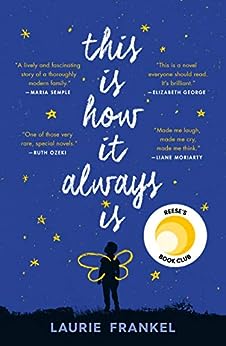
This is a story about a family. Rosie is an emergency room doctor who supports her (unpublished) novelist husband, Penn, and a family of four boys. They decide to try for a girl, so Rosie turns the bed, places a talisman under it, and adopts the proper coital position. The result is Claude, a precocious child who announces at age 3 that he wants to be a girl when he grows up.
Rosie and Penn, being the understanding sort of parents, decide to allow Claude to be whomever he chooses to be. Thinking that Madison, Wisconsin, is not equally understanding, they pull up stakes and move to Seattle. Here, Claude becomes Poppy and has an idyllic childhood. Penn, who runs the household, also spins an ongoing nightly fairy tale for the children, incorporating elements of their life challenges.
As the boys get older, including Poppy, the secret-that-should-not-have-to-be-a-secret begins to fester and eventually ruptures the family’s carefully curated existence.
The family dialogue Frankel has created is uber believable. The family is knit together quite tightly, perhaps too much so. I would have expected a little more friction. Still, the scenes at work, at school, and at home have a delightful, almost nostalgic, charm.
The plot device sending Rosie and Poppy to Thailand is a tad convenient, but quite eye-opening. Since I doubt I will ever visit Thailand, I appreciated the detailed descriptions of the places and culture.
Frankel also tends to add—not exactly foreshadowing—announcements of future events. Some of these “predictions” appear later in the book, others do not. I found them distracting and would have preferred seeing them collected in an epilogue.
This book is a creative read on a very current topic. The author is the mother of a “Claude/Poppy” child, though otherwise her family life is not as depicted in the novel. Hopefully, books like this will help bring about an opening of minds on gender issues in the U.S.
 Eilene Lyon
Thank you for the review. It sounds as though the book gives an inside perspective on a politically charged issue. (Which is none of politicians’ business in the first place.)
LikeLiked by 1 person
I agree that gender should not be political, but it is anyway it seems. This book doesn’t address that so much as just how people generally react to a boy who dresses like a girl (but see girls dressing like boys as normal). The biggest question I had was, “If Poppy sees herself as a girl, why does that necessarily mean dresses, barrettes, dolls, princesses, etc.?” I was a girl and not much interested in any of that. I liked pants, Hot Wheels, and Tonka trucks.
LikeLiked by 2 people
Good point about girls’ not always wearing frilly dresses and playing with dolls.
LikeLiked by 1 person
I knew a boy who liked playing with dolls – nothing girly about him. We still get rather stuck on these conventions.
LikeLike
Yes, we do. I remember my dad being so proud of breaking with social conventions and giving my daughter a Tonka truck.
LikeLiked by 1 person
Good for him!
LikeLiked by 1 person
🙂
LikeLiked by 1 person
I read this book for book club, but i don’t remember it enough to give a pov
LikeLiked by 1 person
I enjoyed it. Something different.
LikeLiked by 1 person
I’ve added this to my list. I’ve worked with very young student who anatomically is a boy but identifies as a girl, dresses as a “girl” The kids don’t seem to have trouble with this, so why can’t adults be as accepting. I agree with what you said above about the stereotypes we still harbour about what is female and what is male.
LikeLiked by 1 person
I’m glad to hear that the kids are accepting, because I know kids can also be cruel to those who are different (speaking from experience – and I was no better than most). This is a good read – poses a lot of difficult questions and doesn’t really offer answers, but has a satisfying ending.
LikeLiked by 1 person