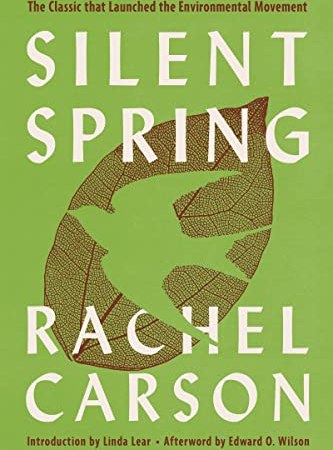
“In some quarters nowadays it is fashionable to dismiss the balance of nature as a state of affairs that prevailed in an earlier, simpler world—a state that has now been so thoroughly upset that we might as well forget it….The balance of nature is not a status quo; it is fluid, ever shifting, in a constant state of adjustment. Man, too, is part of this balance. Sometimes the balance is in his favor; sometimes—and all too often through his own activities—it is shifted to his disadvantage.”
You might think that as an environmental biologist I would have read this book long ago, but I have been deficient in many quarters with my reading. The impressive aspect of Silent Spring is just how relevant it is today, given that it is as old as I am (and I’m no spring chicken, you know).
Carson’s seminal work tackled the chemical industries head on, ushering in the modern environmental movement. It also led to watershed laws protecting our environment—laws that have been embattled and watered down ever since their passage in the 60s and 70s. As Carson pointed out, some people have thrown up their hands in despair that there is anything we can do to change course.
She was both a scientist and a talented writer. Her research into pesticides went wide and deep. She knew the jargon and could translate it for the average reader. She begins her work with a parable: the silent spring alluded to in the title. She then proceeds to illustrate our human folly in trying to control the uncontrollable, with disastrous results.
While many of the chemicals she wrote of have been banned—at least in the U.S. and Europe—many others have been introduced since then. Some, such as DDT, are still in use in parts of the world. Headlines I’ve collected recently have made it clear that we’ve not yet learned our lesson.
Second-generation anticoagulant rodenticides are one example. Though intended only for professional use, anyone can purchase these online for home use. More than ten thousand cases of poisoned children have been reported. Because these pesticides do not kill immediately, predators that consume the toxic rodents accumulate the poison in their bodies. They may die from the poison, or simply be so impaired they cannot properly function. Flaco, the famous owl in New York City, was one such victim.
Erin Brockovich wrote recently about PFAS (“forever chemicals”) that most of us now carry in our bodies. Most of us also harbor microplastics and other toxic substances that have unknown long-term impacts on our health.
And just this morning, I read of mysterious clusters of neurological problems in New Brunswick. They may be related to the widespread use there of glyphosate for weed control, or some other environmental hazard.
It’s a shame that Carson died shortly after completing Silent Spring. So far no present-day work has been able to capture the public’s attention in quite the same way. I do hope such a book—or video—comes along soon.
 Eilene Lyon
Sounds like an interesting and relevant read. All those years ago “we” knew but as you say very little changes. Sad really.
LikeLiked by 1 person
We need a new version of this book to illustrate the current horrors we’re wreaking on our environment (and ourselves).
LikeLiked by 1 person
I remember when Silent Spring made a very big impression on my mother.
LikeLiked by 1 person
Did she join an activist group?
LikeLiked by 1 person