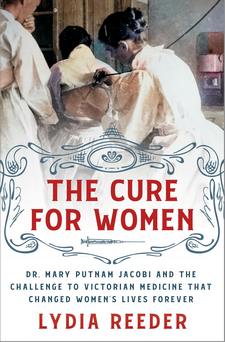
Seldom does a book come along that both infuriates and leaves one gaping in awe. This work is subtitled, “Dr. Mary Putnam Jacobi and the challenge to Victorian medicine that changed women’s lives forever.” That’s a tall order, and Reeder does not disappoint, though “forever” may be a stretch.
This is not precisely a biography of Dr. Jacobi, who does not appear until Chapter 3, but does focus on her through the rest of the book. It looks at the status of women in medicine in the latter half of the 19th century.
I was well aware that when men built medical schools they excluded women. Also, when they took on obstetrics and gynecology, they marginalized and even villainized midwives, staples in family medical care for millennia. Given that women assisting other women with the birth process makes excellent sense, and that giving midwives access to the latest science makes even more sense, it bogles the mind to think how many lives may have been lost due to the misogyny of America’s doctors.
Reeder’s story goes well beyond these basic facts. She begins with the first female graduate of an American medical school, Elizabeth Blackwell, and her sister, Emily. They helped fill the demand by women seeking a medical education with their New York Infirmary and affiliated medical college. The infirmary primarily treated women, children, and the poor, in general.
Other notable female doctors you’ll read of are Ann Preston and Marie Zakrzewska of Philadelphia and Boston, respectively. But Mary Putnam stood out, dreaming of being a doctor from a very early age, and eventually becoming the first woman admitted to the Sorbonne Medical School in Paris. Most of these women relied on education in Europe, since American colleges were largely off-limits.
Jacobi’s story is awe-inspiring. What is infuriating are the male doctors (some hardly worthy of the title) who made it their mission to demean the female sex in any manner they could devise, whether it was barbaric experimental surgeries on Black women (without anesthesia, though white women were privileged to have it), or claiming that menstruation enfeebled women and that if they become educated, they would lose their ability to reproduce.
In scenes that echo today, abortion was outlawed for the first time, and men moaned about falling birth rates and the need for American women to produce more babies.
Along came Dr. Jacobi, who was both highly educated and fertile. Even while she was pregnant (she had two children), she produced vital research and a report on women’s monthly cycles that won the first-ever Harvard Boylston Medical Prize. Her work disproved the disparaging and inaccurate depictions of female biology by male doctors, and led to further advances in women’s health care.
Jacobi and her physician allies and supportive women of the “gilded” class raised funds for a medical school at Harvard, but their proposal was rejected in the end. Many years later, they did succeed in funding a graduate medical program at Johns Hopkins that accepted women from the start.
The story told in The Cure for Women is one that must become common knowledge, now that the female sex is under siege once again. It also touches on the fight for women’s suffrage, a hard-won right that must never be rolled back. If you enjoy reading of the barrier-breaking women who endured what it took to advance equality in America, you must include this on your TBR list ASAP.
 Eilene Lyon
A timely review for sure. It’s just been added to TBR list.
LikeLiked by 1 person
I think this book is going to do well.
LikeLiked by 1 person
This sounds like an important book. The Birth House by Ami McKay is a novel that deals with women’s healthcare at the time of WWI when male doctors were “medicalizing” the natural birth process.
LikeLiked by 2 people
That process started long before the war, unfortunately. I must say I dearly love that BBC show, “Call the Midwife.” Even my husband loves it.
LikeLiked by 1 person
My husband and I love “Call the Midwife,” too.
LikeLiked by 1 person
It was a real surprise to us!
LikeLiked by 1 person