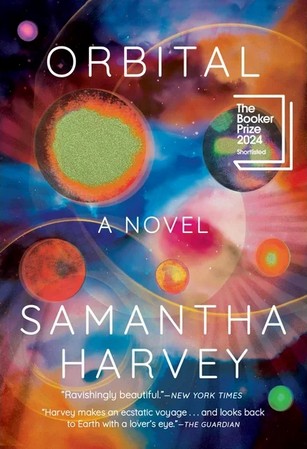
How can one not be tempted to read a Booker Prize-winning book that comes in at just over 200 pages and has cover blurbs like “Ravishingly beautiful” and “Harvey makes an ecstatic voyage…and looks back to Earth with a lover’s eye.” I was ravished! Seriously, this a eye-opening book.
On the surface, it covers a full 24 hours on the International Space Station (ISS) as it makes 16 orbits around our planet. There is a map of the orbits at the beginning, but I found it confusing until I pulled out my globe and tried to recreate them with my finger. The space station’s orbit is a fixed, roughly north-south circle. But the Earth is rotating below them in an easterly direction.
Set in the near future, it is not science fiction, as in the genre, but it is science and it is fiction. However, Harvey relied on extensive information provided by NASA and the European Space Agency (ESA). If you ever wondered what it was like to live on the ISS, the details are all here: what and how the astronauts and cosmonauts eat, their daily work and chores, how they communicate with people on Earth, what they do with their trash, how they exercise and sleep.
That may sound tedious, but the meat of this fascinating read is about these six people, cooped up in this small, precarious, extra-planetary bubble together. Two are Russian cosmonauts, who have their own deteriorating pod, and four astronauts from the U.S. and other allied countries, such as Japan.
We learn about why they determined to go to space. How they feel about the blue ball they’re circling when they can view it without the perspective of the human beings down below (except the glow of city lights in dark passes). The disorientation that comes from seeing multiple sunrises and sunsets in a single day. They also have a unique perspective on a massive typhoon barreling toward the Philippines and mainland Asia, a product of climate change.
Mostly, though, we come to understand how this orbital existence colors their philosophy about life and death, God, relationships, humanity and its impacts on the planet, and the universe and what might be out there. As their bodies deteriorate due to weightlessness (which we learn is NOT due to a lack of gravity), their minds burgeon with deep thoughts. They reflect on their lives on Earth and what it means to be so far removed from it.
This is one small book that I will be rereading.
 Eilene Lyon
I’ve ordered it. I can’t wait to start!
LikeLiked by 1 person
I hope you’ll let me know what you think after reading it!
LikeLike
Sounds interesting!
LikeLiked by 1 person
I thought it was a unique premise and done very well.
LikeLiked by 1 person
This has been on my tbr for awhile
LikeLiked by 1 person
Let me know what you think after reading. I’d be very interested in hearing your opinion, LA.
LikeLiked by 1 person
👍👍
LikeLiked by 1 person
This sounds almost like creative nonfiction?
LikeLiked by 1 person
It truly is fiction. All the characters are made up. There’s also a spaceship heading to the moon in the story. But the setting is very real and realistically portrayed.
LikeLiked by 1 person
I can see why it won a Booker Award, then! I think it’s encouraging that in the age of generative AI, novelist can create thought-provoking fiction that has never been done beore.
LikeLiked by 1 person
Indeed. It really is different and creative!
LikeLiked by 1 person
Wonderful post 🙏🎸
LikeLiked by 2 people
Thank you!
LikeLike