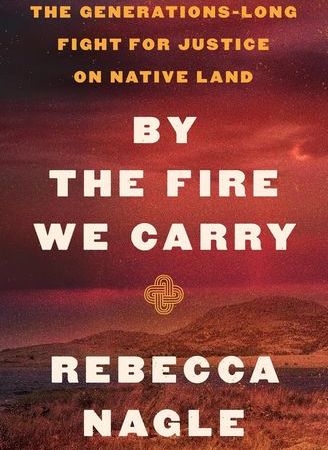
Nagle’s book centers on a case that traveled from Oklahoma to the US Supreme Court from 2019 to 2022. The effect of the decision, which stretched out over two court terms, impacted five Native American tribes that had originated in the eastern part of the continent, and had been forcibly removed by the Andrew Jackson administration in the 1830s.
Nagle is a journalist and enrolled member of Cherokee Nation, one of the five impacted tribes. She has a very personal connection to the removal: two of her ancestors—Major Ridge and John Ridge—were assassinated by their own tribe for having fraudulently signed a treaty agreeing to relocation.
The story begins with a murder in rural Oklahoma. Though this murder is central to the Supreme Court case, I felt Nagle added gruesome details that were not relevant. Patrick Murphy (along with two juveniles) was convicted for killing his cousin, George Jacobs. Both were enrolled members of the Muscogee (aka Creek) Nation.
Though this book focuses on the Cherokee and Muscogee removals, you can be assured that the US government’s duplicities affected all Native tribes in this country. I was already familiar with the “Trail of Tears” that led to the deaths of thousands of Cherokees and others. But the details of all that led up to the final expulsion came as a real eye-opener.
Because we are a nation of immigrants, we should not overlook why our European ancestors came here. They wanted what they could not obtain in their home countries: cheap land. And they were determined to get it, regardless of the fact that the continent was already occupied. The government nearly always gave in to settler demands, excusing this behavior by labeling the indigenous people as sub-human savages.
Even though some Indigenous Nations assimilated in many ways, the Cherokee in particular, they could never become equal to white Americans in the government’s eyes. Settlers took over houses, farms, and plantations owned by the Cherokee as if the owners were as insubstantial as ghosts.
Another aspect of Cherokee Nation that Nagle covers extensively is something less well known. Many of them owned enslaved African Americans, and these people were also force-marched to Indian Territory (Oklahoma), where they continued to be enslaved until after the Civil War.
The issue in the Murphy v. Oklahoma case hinged on whether Patrick Murphy’s death sentence could be carried out by the state. His attorneys argued that the murder took place on the Muscogee Reservation, and thus the state had no authority to prosecute Murphy. Oklahoma argued that the reservation, guaranteed by treaty, had been eliminated upon statehood.
Nagle has done extensive research drilling into the background on the case, the history of tribal removal, and the details of the legal arguments and how they were presented to the Supreme Court. The recent Court’s history on tribal matters came as a surprise to me, too. Nagle also lambasts media coverage and how it is misused in court, and in shaping public perception.
This is a crucial history for understanding tribal sovereignty issues today, as well as flaws in our legal system. I highly recommend the book with a trigger warning about the murder.
 Eilene Lyon
With Orange Shirt Day approaching, our National Day for Truth and Reconcilliation, it is so important to acknowledge and understand how we came to be in the place we are today. This sounds like a read that would help with that journey.
LikeLiked by 2 people
We could use a National Day like that, too. But it seems more likely going the other way—pretend all this never happened.
LikeLiked by 2 people
That’s really too bad. We do have that day, but it is important to honor Truth and Reconciliation in our actions every day. That being said, we still have a long ways to go!
LikeLiked by 2 people
Good point. And yes, a long way to go. We have much to learn from indigenous cultures, too.
LikeLiked by 2 people
Absolutely!
LikeLiked by 1 person
👍
LikeLike
The whole Manifest Destiny justification for basically destroying the indigenous peoples of what is now the US is still unconscionable to me.
LikeLiked by 2 people
My next book covers some of that. It was quite the awful thing. Not just racism, but a Christian imperative thing (and sanctioned by the pope).
LikeLiked by 1 person
Even worse!
LikeLiked by 1 person
People can be awful! And wonderful.
LikeLiked by 1 person
True.
LikeLiked by 1 person