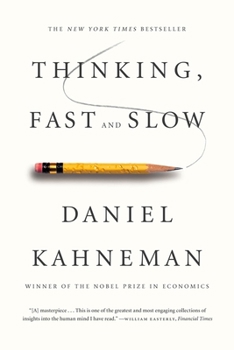
This bestselling book is nonetheless an academic tome. But worthwhile reading. Kahneman was a psychology professor at Princeton who applied his theories to economics, for which he won a Nobel Prize. I was intrigued by the title, because I consider myself to be a “slow thinker” in the sense that, while I am reasonably intelligent, I am usually the last person to get the joke.
However, that sort of being slow is not what he refers to in this book. He euphemistically calls these “System 1” (fast thinking, relying on snap judgments) and “System 2” (slow thinking involving critical analysis). There aren’t really two systems and we all do both types of thinking.
The fast thinking enables us to rely on pattern recognition based on past experience. We can make decisions quickly and not waste time. But this system is lazy in the sense that we use it to misapply past experience to something novel. We don’t answer the right question, therefore we come to erroneous conclusions.
Slow thinking is required to overcome this handicap. Examine the evidence with fresh eyes, so to speak. Carefully consider the actual question and analyze it for the best solution.
The book is arranged in chapters that build on various theories of decision-making. Each presents the core concept in an experimental example. He invites you to play along. Unfortunately, some of the examples are clearly intended for an academic audience, not necessarily the general public. But others are drawn from “normal” life experiences. The chapters conclude with some quotes that illustrate how the concepts can be applied in real-life situations that require better analytical thinking.
What I enjoyed about this work (which took a long time to read, studying one chapter at a time), was learning more about how we come to faulty conclusions. Logic is something that I like to believe is strongly embedded in my thought processes. And I did do well with many of his tests, showing that I do trend toward System 2 slow thinking. But I am still capable of falling into the traps set by System 1 thinking.
This is a work that bears referring back to regularly, as these concepts are not intuitive. If learning more about the way your mind works intrigues you, Kahneman’s book will do a good job of educating you.


I do enjoy some metacognition!
LikeLiked by 1 person
This would be up your alley then!😊
LikeLiked by 1 person
🙂
LikeLiked by 1 person
This intrigues me
LikeLiked by 1 person
It’s a great piece of work. Sip, don’t gulp.
LikeLiked by 1 person
😉👍
LikeLiked by 1 person
This is interesting. I can think of instances where I’ve used both systems. It really depends on the situation. Mind you I’m making a snap judgement now without having read the book!
LikeLiked by 1 person
Hahaha! Yes, we certainly do take mental shortcuts to save time. (Not reading the book will save you a lot of time.😊) Still, I found a lot of it quite fascinating.
LikeLiked by 1 person
I love stuff on the brain! But, I probably won’t add the book to my stack!
LikeLiked by 1 person
I’ve got another “brain book” in my stack, but no idea when I’ll get to it.
LikeLiked by 1 person
One I enjoyed and was an easy read is Remember: The Science of Memory and the Art of Forgetting by Lisa Genova.
LikeLiked by 1 person
Thanks for the recommendation. I could stand to forget a few things!
LikeLike
This is intriguing. Operating in very creative environments I don’t always feel like my logical mind gets a good workout. I recall that I did quite terribly on the logic part of the GRE exam I took before grad school, but I was going to school for creative writing. No one cared that my logic was clearly faulty but it did bother me. Hopefully, I’ve picked some up in the last 20 years, but I’m not sure I ever had a real foundation for logic in the first place!
LikeLiked by 2 people
Even in creative endeavors, such as novels, logic is important to many readers (though certainly not all). But when we get too bound up in it, our creativity suffers. Balance, always seek balance, I think is the answer. Easier said than done, right?🙂
LikeLiked by 1 person