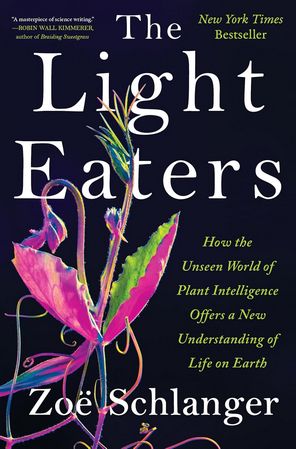
If ever there was a book to appeal to a botanist such as myself, this is primo! But even better, it’s written for people who aren’t scientists. Schlanger quit her job as a staff writer for The Atlantic to pursue a subject that had fired her curiosity for years: What is the true nature of plants?
Inspired by walks through the Hoh Rain Forest, she set out on a surprising journey of discovery. And lucky for us she did, because interpreting the technical aspects of scientific papers for non-scientists is an incredible skill. Beyond that, though, her interviews with the scientists themselves revealed depths of understanding not expressed within the papers’ confines.
One of the first things that should jump out at you: plants are the oldest form of life on earth, and virtually all other living things depend on them for sustenance. Beings that have survived for billions of years must have developed some extraordinary adaptive strategies. They must be smart, in fact. How can this be, in the absence of a brain or even a nervous system?
Plant intelligence, Schlanger reports, is an idea that makes many botanists uncomfortable. Possibly it would discomfit anyone who eats plants from necessity. It’s much easier to make the case that we shouldn’t eat beings that have a closer resemblance to us: having legs, eyes, brains, etc. Try it again after reading The Light Eaters!
Plant blindness is a common phenomenon. People look around them and see green. Ho hum. That’s a tree, those are shrubs, this is grass. Taking a closer look, not just at morphology, but also behavior, can come as a shock.
Discover here that plants not only compete with one another, but can defend themselves, or aid relatives. Defense is not simply a passive matter, either. Sure, plants have spines or produce toxic chemicals. But they can even summon predators to attack whatever is attacking them. They can send chemical signals to warn other plants to start producing more toxins. This is active warfare.
The signals plants send can even target specific other plants. Somehow, they can identify siblings and other close relatives. Astonishing. Plants will compete with non-relatives of the same, or different, species, but cooperate with family.
As a gardener, I manipulate plant growth in a variety of ways. I remove “weeds” (are there really such things?), and I snip spent flowers. I pull leaves off my lettuce and prune my shrubs. These are not benign actions to the plants. They experience physical reactions, something like pain, but without neurons. I’ve developed a new sense of guilt. How can I comfort these living things I am harming? That (Who?) provide the very oxygen I breathe?
We tend to filter out uncomfortable truths such as this. There simply is no way to live without sacrificing other lives to sustain our own. Unlike humans, though, other animals—and plants, too—are unsentimental or introspective about this. It’s simply a fact of life. Well, it’s about supper time. I think I’ll have a large salad with some grilled chicken…
 Eilene Lyon
Yikes! I think we have to filter out the harm we are doing in order to survive. When I harvest, I will have to be more mindful of giving thanks. It’s the fact that they might feel pain that bothers me the most.
LikeLiked by 1 person
When you think about it that way it’s easier to understand how people manage to work in slaughterhouses or even people who harm others criminally. It takes a stronger filter, but it’s a matter of degree. But you’re right, we need that to survive. I’m trying to be more cognizant of my harms to plants, too. Thankfulness may be the best that we can do.
LikeLiked by 1 person
What a fascinating read. Though I really don’t need added guilt for pulling a carrot out of the earth, or cutting off a few leaves of lettuce!
LikeLiked by 1 person
Very true. I’ve come to terms with it. I still am intrigued by what science is learning about plants.
LikeLiked by 1 person
It is fascinating. Like the fact that trees speak through their roots.
LikeLiked by 1 person
And other ways, too. I’ve read a lot about plants, but learned many surprising new things.
LikeLiked by 1 person
You are the second to recommend this book. I shall have to put it on the list!
LikeLiked by 1 person
I was surprised in came out in paperback so quickly. It’s a bestseller.
LikeLiked by 1 person
The cost of books is quite high – I’m sure people prefer to have the paperback (when not in eReader form).
LikeLiked by 1 person
That’s true. But my experience is that publishers tend to wait a couple years.
LikeLiked by 1 person
I imagine things change for some publishing houses, anyway.
LikeLiked by 1 person
No doubt.
LikeLiked by 1 person
Whoa! I had no idea!!
LikeLiked by 2 people
Truly astonishing revelations!
LikeLiked by 1 person