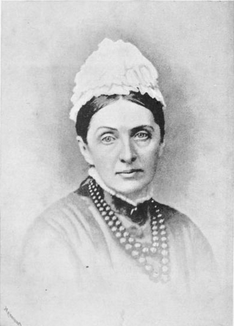
Picture yourself as a Victorian-era British spinster, religious and socially proper. Then put yourself alone on horseback in the undeveloped wilds of the Colorado Rocky Mountains…alone…in winter…at night. Surprisingly, that’s one of the more pleasurable aspects of Bird’s time in my home state, back before it was even a state.
Last month I read a pair of books—one by Isabella L. Bird, A Lady’s Life in the Rocky Mountains; and one about Bird, Amazing Traveler Isabella Bird, by Evelyn Kaye. I first read Rocky Mountains many years ago, so this was a reread in conjunction with Bird’s biography.
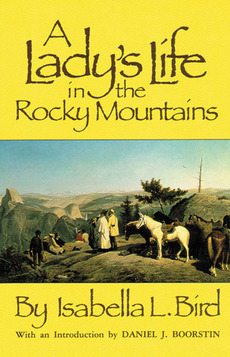
Bird’s Colorado travels in 1872 did not mark her first time in the United States. She even published two books related to her trip to eastern Canada and the U.S. in 1854 when she was twenty-two. Her travels were an outgrowth of her suppressed resistance to female repression. This unacknowledged chafing exhibited as physical maladies. Her doctor sent her off to roam the world, and the ailments soon vanished.
Bird and her sister, Henrietta, grew up in a well-to-do household, though their father was an unpopular minister. His passion was keeping people from breaking the sabbath by working, never seeing the irony that his work fell on that day. Farmers with cows to milk didn’t find him amusing. They would soon boot him off to some other parish. He died when the girls were still young. They and their mother moved to Edinburgh, Scotland.
The Bird sisters were uncommonly close, bonded unto death-do-them-part. When Isabella’s pains again became insufferable, she set out on a world tour that took her to Australia and New Zealand. On her way to San Francisco, a sick boy on the ship required a stop in the Sandwich Islands (Hawai‘i). She remained there, enthralled with the volcanic islands and their inhabitants, for many months.
Reluctantly she continued her journey to San Francisco and immediately set out for Lake Tahoe. After two days’ adventures there, she boarded a train to Cheyenne, Wyoming, and then Greeley, Colorado. She loathed both places deeply.
Bird had many disappointments on the way to her ultimate destination, Estes Park. This isolated valley near the base of Colorado’s iconic Longs Peak, completely reversed her opinion about the West. She fell in love with the wildlife, plants, weather, and open space. And Rocky Mountain Jim, a “desperado,” fell in love with her.
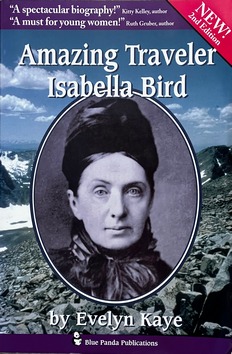
In Kaye’s biography, she summarizes the Colorado adventures, and those of Bird’s other travel books. Because she went directly to Bird’s original letters to Henrietta (and others), she also included aspects of Bird’s journeys that were not shared in her edited versions for publication. This provides a deeper understanding about this traveler’s personality and challenges.
As astonishing as this world trip turned out to be (spawning two more books), her travels in her 50s and 60s left me gobsmacked. As Kaye puts it in her introduction, “Isabella never had a boring trip,” an understatement. She studied her surroundings and people to create vivid, lively descriptions. And she was always up for an adventure, no matter how daunting or dangerous. Thirst, starvation, cranky animals, dangerous men, deadly storms—she survived them all, in a dress.
There’s no doubt that I will delve into Bird’s other books about Hawai‘i, Japan, China, India, Tibet, Sinai, and Persia. Most are still in print. The places she went have changed dramatically since her visits, so her narratives take us to a different time, as well as place.
Though her writing is filled with superlatives, you will relish her energy and enthusiasm (or disgust). There’s no doubt that she took a keen interest in everyone she met and every new experience. She was uncommon and courageous. She was also respected enough as an observer and chronicler to be admitted to the Royal Geographic Society in England and Scotland.
I recommend both these works as a good place to meet the indomitable Ms. Bird. Her like may never be seen again.
 Eilene Lyon
These two books sound fascinating! I hadn’t heard of Isabella Bird before.
LikeLiked by 1 person
I hope you decide to learn more about her. She was quite the spirited traveler.
LikeLiked by 1 person
You’ve got me curious. You’ve got to stop writing these reviews my to be read pile keeps growing! lol
LikeLiked by 1 person
😁 I know, I know.
LikeLiked by 1 person