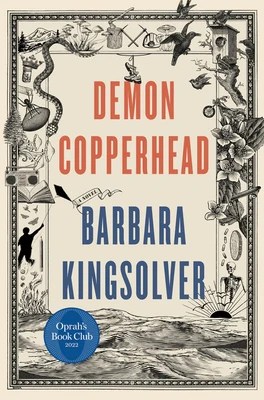
I’m a devoted fan of Barbara Kingsolver, having read just about everything she’s ever written. Perhaps it’s because I identify with her as a biologist, writer, and historian. Unlike Kingsolver, though, I am not a novelist, mother, or farmer. She has talents I can only dream of.
Charles Dickens’s David Copperfield served as a model for this story of a struggling lad in impoverished circumstances in Appalachia, born in the 1990s. It isn’t necessary to have read Dickens, which I wouldn’t touch with a 50-foot pole, as I’ve mentioned previously. Even a familiarity with the plot is irrelevant, but you can find it on Wikipedia.
One thing I gathered from Wikipedia is that Damon Fields (the titular “Demon Copperhead”) is no David Copperfield. Copperfield (loosely autobiographical) may have found himself in difficult circumstances, but he also had gumption and a drive to succeed.
Copperhead, on the other hand, seems to consign himself to “fate” more often than not. This is probably due to Kingsolver’s ambition to tell a story about this country’s opioid crisis. How much purposeful drive (in a good direction) do we expect from an addict?
One criticism of the book is its heft. I felt engaged with the story through the entire 546 pages, which is unusual. I like tight narratives. Yes, it could have been shorter and with fewer characters to track. The entire tale is related by Damon in first person. It puts you in his head and keeps you there. He’s a witty, astute narrator.
Another complaint I found, by someone who works in social services, was the negative depiction of this type of agency in the story. Well, if you are at all familiar with the crises of the foster care system in the U.S., or if you’ve ever struggled to find redemption while dealing with any government agency, Kingsolver’s view will not offend.
There is no shortage of tragedy in Demon Copperhead. Just as there is no shortage of same in the real-life world used as the backdrop. A few amazingly strong characters (mostly women, no surprise) manage to pull Damon from his downward spiral, albeit arresting his fall only temporarily.
Kingsolver cleverly renames and modifies many of Dickens’s characters to serve her literary goals. Uriah Heap becomes U-Haul, for example. While some come across as realistic, others are sketched as caricatures. As stated, it can be a challenge retaining the cast in your head.
One thing that comes across in the book is the rural/urban divide in this country. Damon bemoans the time he spends in Knoxville, more concrete than jungle. He sees the typical urban dweller as lacking self-sufficiency, unlike those who hunt, fish, and farm where he comes from. He misses his kinship with the wild elements.
Overall, I enjoyed this book and thought it offered some sympathetic depictions of the people who are caught up in the opioid crisis. Though bleak at times, there are hopeful scenes and beauty, as well. I’d give it 4/5 stars.
 Eilene Lyon
I have debated reading this. My guess is eventually one of my book clubs will read it
LikeLiked by 1 person
She knows this area of the country and its people very well. I thought she developed some very real characters and situations.
LikeLiked by 1 person
👍👍
LikeLiked by 1 person
I don’t think I’ve read any Barbara Kingsolver, although I am aware of her as an author. I will add this to the list, but it won’t jump the queue, based on the your review of length and character complexity.
LikeLiked by 1 person
I’ve only read “The Poisonwood Bible” (as most, I figure, it being an Oprah pick way back when 😉 I did enjoy that and I often wondered if I should pick up another.
I’ve never read David Copperfield, either 🙂
LikeLiked by 1 person
At 15, I was supposed to finish my freshman year by correspondence course and they deemed making me read “Great Expectations” was a good idea. Not!! I could never get through it. I won’t ever look at another Dickens book. I think Kingsolver may have strained a bit much to cram in all the Dickens characters, even when it would have been better to leave a few out.
LikeLiked by 1 person
So…. no A Christmas Carol? no, Oliver Twist? 😉
I’m thinking you like the genre or not.
I feel the same about Ernest Hemingway. Blech.
Good to know, should I ever feel like digging into this one!
LikeLiked by 1 person
No. A thousand times, no! I probably would be more appreciative at my current age than at 15, no doubt. But my book piles are big enough already. I do read classic works, even challenging ones, but sparingly. I probably won’t take on Dostoyevsky, for example.
LikeLiked by 1 person
Haha! I feel ya. Nope on Dostoyevsky. I had enough with Tolstoy, thank you very much. Russian writers do love to go on and on…
I like to take on a classic now and again, myself. Which is why I read “For Whom the Bells Toll” which annoyed me to no end. Blow up the bloody bridge, already, so I can get outta here!
LikeLiked by 1 person
I still have yet to read one of Kingsolver’s novels, although I feel I should.
LikeLiked by 1 person
Some are better than others, but I enjoyed them all.
LikeLiked by 1 person
Have you read Unsheltered? Someone gave it to me several years ago.
LikeLiked by 1 person
I have. I liked it because I’m a botanist. And for the history.
LikeLiked by 1 person
Thanks!
LikeLiked by 1 person