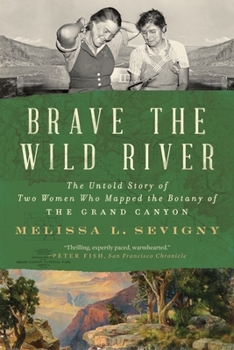
As soon as I knew about Sevigny’s book, I put it on my TBR list. It’s the true tale of two botanists, both women, who rode the Colorado River through Cataract, Glen, and Grand Canyons to document the flora of the canyons and collect specimens in 1938.
Having spent much of my field biology career identifying plants, cataloging them in a college herbarium, and collecting specimens, I consider myself a botanist, too. And I made a journey on the Colorado through the Grand Canyon in 2014. It was the most amazing trip of my life.
Very few people had ever been down the Grand Canyon by water as of 1938, and no (non-Native) women had ever completed the trip. (Glen and Bessie Hyde made the attempt in 1928 and disappeared somewhere beyond the Bright Angel Trail.)
Elzada Clover taught in the botany department at the University of Michigan, and Lois Jotter was a graduate student Clover selected to accompany her. It would have been socially unacceptable at the time for her to be the only female on the expedition. Despite Clover’s accomplished career, she was not granted a full professorship until 1960. That gives you just a hint of the discrimination Clover and Jotter experienced.
They enlisted the services of Norm Nevills, who built three small cataract boats and hired a boatman to assist him down the river. This would be his first time running the Grand Canyon. The sixth member of the expedition was a zoologist named Atkinson. Atkinson and a man named Harris left the expedition at Lee’s Ferry and two new members were enlisted to row.
Not only were Clover and Jotter there to work on their botany project, they were expected to do everything in camp, including cooking and clean-up. Jotter even helped row in the flat-water areas. She wanted to run rapids, but Nevills would not allow it.
Something that I found difficult to understand had to do with the women’s irritation at their portrayal in the press. Much of it was inaccurate, and it always focused on their sex, not their work. Both published regularly in scientific journals. Why would they not publish their own version of the events on the Colorado? After all, they were there for the entire journey, the journalists were not.
But perhaps I’m giving too much credit to the openness of the media with regard to accepting any stories written by Clover and Jotter.
Sevigny clearly did her research, greatly aided by the women’s journals, as well as those of other expedition members. She points out the errors in news reports, and does an excellent job of bringing these people to life. The Grand Canyon, of course, features as one of the main characters. The use of metaphors struck me as overdone at times, but there is nothing flat-water about her prose. It rolls and dives, splashes and hurls, much like the river itself.
For some reason, it was not until the end of the book that I realized a cactus here in the Four Corners was named for Elzada Clover: Sclerocactus cloverae, Clover’s fishhook cactus. One of the subspecies, known as Brack’s fishhook cactus, is a threatened species I spent countless hours locating in the field to help prevent their destruction by the oil and gas industry. I’m so happy to know much more about this accomplished botanist.
 Eilene Lyon
I love to hear about women who had significant contributions to the past. I always like to have a nonfiction summer read for the porch. This ” ….there is nothing flat-water about her prose. It rolls and dives, splashes and hurls, much like the river itself.” may have helped to add it to the list.
LikeLiked by 1 person
The topic was right up my alley, as I explained. But I also found it an excellent expose on how professional women still had so much patronizing and discrimination to overcome back then.
LikeLiked by 1 person
No kidding, heh. There was a total lack of respect. Clearly evident in them having to do all the traditional female camp chores.
LikeLiked by 1 person
Now you’ve made me add it to my TBR list!!
LikeLiked by 1 person
I’m dangerous that way!
LikeLiked by 1 person
My kind of danger 😉
LikeLiked by 1 person
This sounds like a fascinating piece of women’s history!
LikeLiked by 1 person
It really spoke to me, with all my points of connection.
LikeLiked by 1 person
I can see that! It’s always gratifying to find a book like that.
LikeLiked by 1 person
🙂
LikeLike