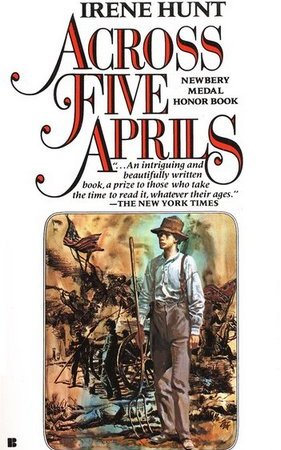
Quite a few of my ancestors lived in Indiana and Illinois during the Civil War era. Some of these relatives served in the Union Army. But these two states had many residents who hailed from Kentucky, Tennessee, Virginia, and the Carolinas. For that reason, some communities were torn by conflicting loyalties.
Hunt’s book, published during the Vietnam War/Civil Rights era, is also reflective of those more recent divisive conflicts. Her story is based on the family recollections of her grandfather, who was nine years old when the Civil War began in April 1861. Her fictional stand in, Jethro, matures over the years until war’s end in April 1865.
Jethro’s large family lives in Jasper County, Illinois, one of those torn by sectarian suspicion and violence. His oldest brother went to California during the gold rush and was not heard from again. Brother John has a wife and children. Tom and Bill were the closest of the boys and were soon drawn into the conflict.
Bill is depicted as the quiet intellectual of the family who originated in Kentucky. While he agrees with the rest of the family that slavery is wrong, he feels the federal government has imposed unreasonable burdens on the South in the form of punishing tariffs. He decides to join the Confederate Army.
Tom and John, and the schoolmaster, Shadrach Yale, all join the Union. Shad is the sweetheart of Jethro’s sixteen-year-old sister, Jenny. Jethro respects Shad and the education he receives from him. Shad’s departure, along with his three older brothers, is hard for the entire family.
When the patriarch, Matt, suffers a heart attack, the work of running the entire farm falls to Jethro and Jenny. Their mother, Ellen, has her hands full with the housework, and dealing with migraines brought on by a lack of coffee.
There are bad feelings between Jethro’s family and a local family of ne’er-do-wells. One of the sons was responsible for the death of Jethro’s sister, Mary, in a carriage rollover. Jethro must confront these people, as well as community members who believe Jethro’s family are Southern sympathizers, because of Bill.
Probably because this story is based on Hunt’s ancestors, the characters and their difficult situations bring the war period into a clearer focus for those so far removed from that time. Even in his home state, people were quite critical of President Lincoln, for example.
Citizens at home followed the events of the war through the newspapers and developed strong opinions about the Union generals. Their loyalties were fickle, as the generals won or lost various battles. Letters home, such as one from Tom, illustrate some tragedies among the ranks of soldiers, unrelated to battle.
Though this is a young adult novel (in my local library, it was surprisingly shelved in the children’s section, despite rather mature content), I felt it was one of the more true-to-life fictional works about the Civil War. As a bonus, it reflects what my ancestors in those midwestern states may have endured.


Sounds like the type of book I enjoy reading.
LikeLiked by 1 person
If history is your thing, this is a top-notch selection.
LikeLiked by 1 person
Added to my “Want to Read” 🙂
LikeLiked by 1 person
😊
LikeLiked by 1 person
This book sounds very interesting. I think it would be a good book for young people to read right now to see how Jethro navigated such a divisive time, which is upon us again.
LikeLiked by 1 person
I agree. He really had some challenges to deal with. For many reasons, today’s youth could stand to learn these lessons to become more resilient.
LikeLiked by 1 person